Technical
AI training
How the speech models are trained: what goes into each run, how the mix has changed from version to version, and how the first checkpoints compared. The models themselves are on Models.
The recipe stays much the same from version to version; the explorer below it shows how the amounts changed.
The training blend
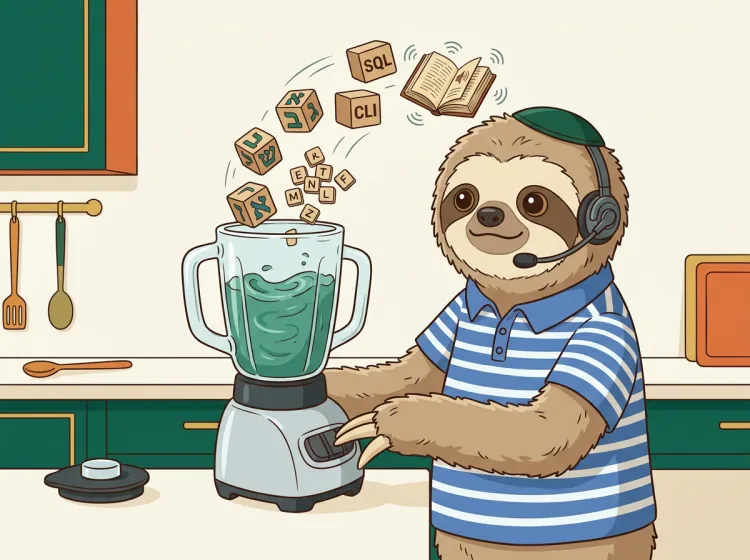
Every training run is a blend, and each clip goes into exactly one of five ingredients. Fine-tuning on code-switched speech alone tends to damage a model's ordinary English, so the job of the blend is to teach the new skill while the model keeps what it already knew.
- Code-switching. English sentences with Hebrew words in them. This is the task itself and the largest ingredient in every version.
- Priority words. Words my dictation got wrong. Each take appears up to three times in a run, with the extra copies capped at 10% of the run's audio, so the model sees its mistakes more often without overfitting to them.
- Tech vocabulary. Model, product and command-line names, acronyms and brands, which stock models tend to mangle.
- Other English. Numbers, emails, messages and everyday English in the same voice, so the model doesn't learn that this voice means Hebrew is coming.
- LibriSpeech replay. Public English audiobook clips, read by other people, held at about 10% of the blend. They are there to stop the model forgetting: LibriSpeech is part of what stock Parakeet learned from, so it works as a regular reminder of plain English. The 10% follows published work on experience replay, where that share cut forgetting sharply without hurting the new domain.
A full retrain starts from the stock base. A rolling update starts from the previous version's weights and runs far fewer epochs, on new clips plus older ones. Test clips are held out of training and never repeated.
What each version was trained on
Pick a category to follow it on its own, in hours and as a share of the mix. Pick a version for its details.
Early checkpoints side by side
The first Parakeet, Nemotron and Whisper fine-tunes, with what each was trained on and its validation numbers during training. The current models are on Models.
| Jachnun (Parakeet fine-tune) | Shakshuka (Nemotron fine-tune) streaming | Whisper Small fine-tune | |
|---|---|---|---|
| Base model | nvidia/parakeet-tdt-0.6b-v2 | nvidia/nemotron-speech-streaming-en-0.6b | openai/whisper-small.en |
| Architecture | FastConformer encoder, TDT decoder, 0.6B | Cache-aware FastConformer encoder, RNNT decoder, 0.6B | Whisper encoder-decoder, 244M |
| How it transcribes | The whole clip, after you stop speaking | Streaming, in chunks of 80 to 1,120 ms while you speak (also offline) | The whole clip, up to 30 seconds. ACFT lets it process only as much audio as the clip is long |
| Current checkpoint | Jachnun v1.0: checkpoint 6, run r6-en30, 2026-10-19 | Shakshuka v2.1, run r28-shak, 2026-11-05, on Sabich's data, not benchmarked yet (the rows below describe PoC-2, run r6-nemotron-en30, 2026-10-19) | Run small-en-en30-acft, 2026-10-17 |
| Trained on | Read-Aloud-Voice-Sentences 550bfcaa, 2026-10-19 behind | Read-Aloud-Voice-Sentences 550bfcaa, 2026-10-19 behind | Read-Aloud-Voice-Sentences 36845b0d, 2026-10-17 behind |
| Training data | The same for both: 339.2 min of code-switched speech (3,224 clips), 95.3 min of the speaker's own English, 48.5 min of LibriSpeech replay. 20 epochs on one L40S | Earlier and smaller: Read-Aloud-Voice-Sentences as of 2026-10-17, 1,929 clips (215 min: 152.5 code-switching, 40.5 own English, 22.0 public English). 10 epochs | |
| Validation WER (training) | 5.0% | 6.3% (offline decoding) | 3.3% (its own validation set) |
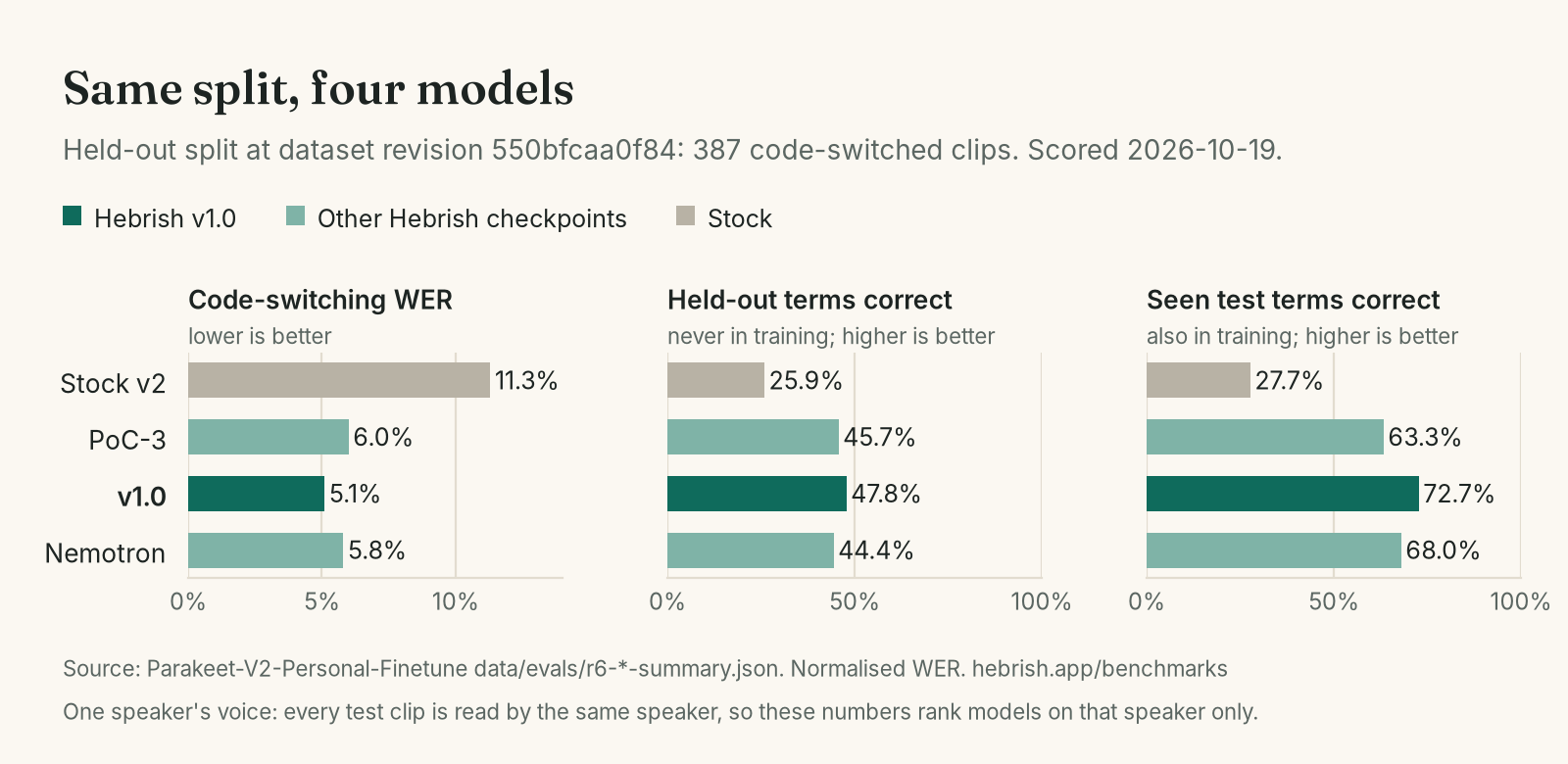
| Benchmarked | Yes: v1.0 73.3% term recall, 3.3% WER on the public benchmark | Public benchmark (offline): 62.2% term recall, 4.7% WER. Streaming at 560 ms: 5.65% CS WER, same as offline | Yes, on its own test set: 5.8% code-switching WER in FUTO's runtime. Not comparable with Parakeet's |
| Formats | .nemo, GGUF, ONNX, sherpa-onnx int8, MLX | .nemo, sherpa-onnx int8 (streaming), GGUF | whisper.cpp GGML Q8_0 (264 MB), Transformers fp32 |
| Used by | The browser demo; no longer offered in the Hebrish apps (since Android 1.013 and Desktop 1.020, 2026-11-04) | The Hebrish desktop app (0.7.0+, Ubuntu and Windows), as Shakshuka v2.1; not on Android yet | FUTO Keyboard and FUTO Voice Input (Android), imported by hand |
| Licence | CC-BY-4.0 | NVIDIA Open Model License Agreement | MIT |
The Parakeet and Nemotron validation numbers are raw WER on the same 218-clip validation set, measured during training. Whisper's is on its own, smaller validation set. None of them are benchmark results, and the set is larger than earlier versions' sets, so they do not compare with older checkpoints. Benchmarked results: model card.